
Discover our white papers
Large accounts are won and kept through relationships: who influences whom, who carries weight in a decision, and how strong your ties are with each of them. Yet this relationship capital is rarely mapped, measured or managed as rigorously as pipelines and forecasts.
Our white papers explore how to change that. They draw on the RIIM™ method (Relationship Intelligence & Influence Management), on EKAM (Ecosystem Key Account Management), and on more than twenty years of work with strategic sales and key account teams in industry, energy, construction and consulting.
Each paper is written for sales leaders, key account managers and executives who want practical frameworks they can apply to their own accounts, not theory for its own sake.
-
For years, key account management followed a simple logic. Select the right accounts, map the organization, identify the key people, then push a strategic project through the right doors. It worked as long as the org chart told you who made the decisions.
That is rarely the case today. Buying committees have grown, decisions span several entities, and the people who matter change roles, or companies, faster than any account plan can keep up. Influence now sits as much with a trusted advisor, a partner or an integrator as with the person who signs the purchase order. Remote work has made these networks even harder to read.
The account manager is not dead. But the model built around a single account and a static org chart has reached its limits. Ecosystem Key Account Management (EKAM) starts from a different premise: every key account sits within a wider ecosystem, and that ecosystem is where value is created and decisions are made.
This white paper explains what changes when you manage the ecosystem rather than the account alone. It shows how to read real power rather than formal hierarchy, how to coordinate who engages whom across your organization, and how to turn relationships into an asset the whole company can manage. It draws on RIIM™ (Relationship Intelligence & Influence Management), the methodology developed by Perfluence with strategic account teams.
-
Winning a key account used to come down to a strong offer and a solid relationship with the buyer. That is no longer enough. Today’s decisions are shaped by a wider circle of executives, advisors, partners and integrators, and access to that circle has become fiercely contested.
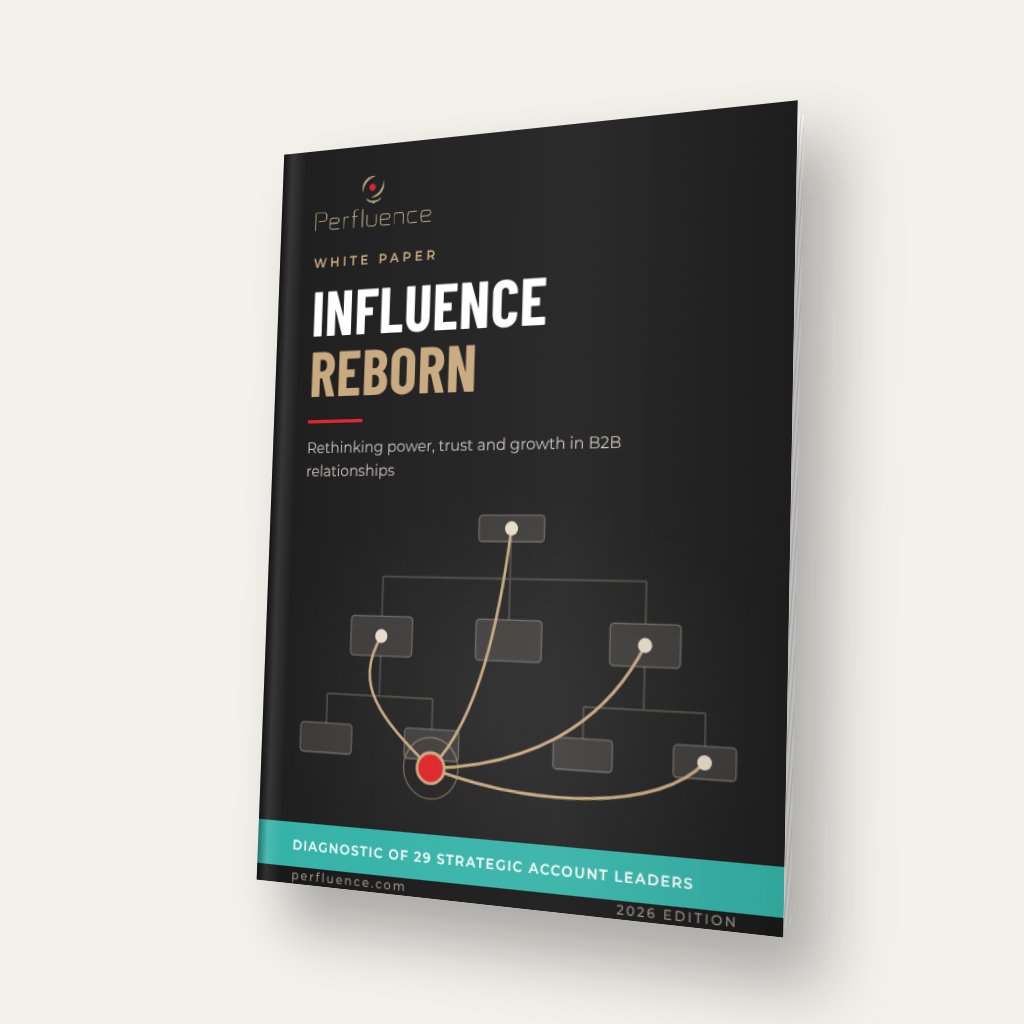
To understand how organizations are responding, Perfluence asked 29 strategic account leaders and sales executives from some twenty European companies to assess how they handle influence around their key accounts. The diagnostic was run live during the “Influence Reborn” session at SAMA’s European conference in October 2025.
The results reveal a striking paradox. Almost everyone sees the challenge: 89% say their organization needs to get better at handling influence dynamics, and three in four feel competition for access has become sharper and faster. Yet only 17% say they clearly see the real power map at their customers, and just one in four has a process to preserve relationships when a key contact moves on.
This white paper explores that gap between awareness and practice. It looks at where organizations stand today, what separates the most mature teams from the rest, and how to move from intuition to method: mapping real power rather than the org chart, building political risk into account reviews, coordinating engagement, and managing relationship capital as a true corporate asset.
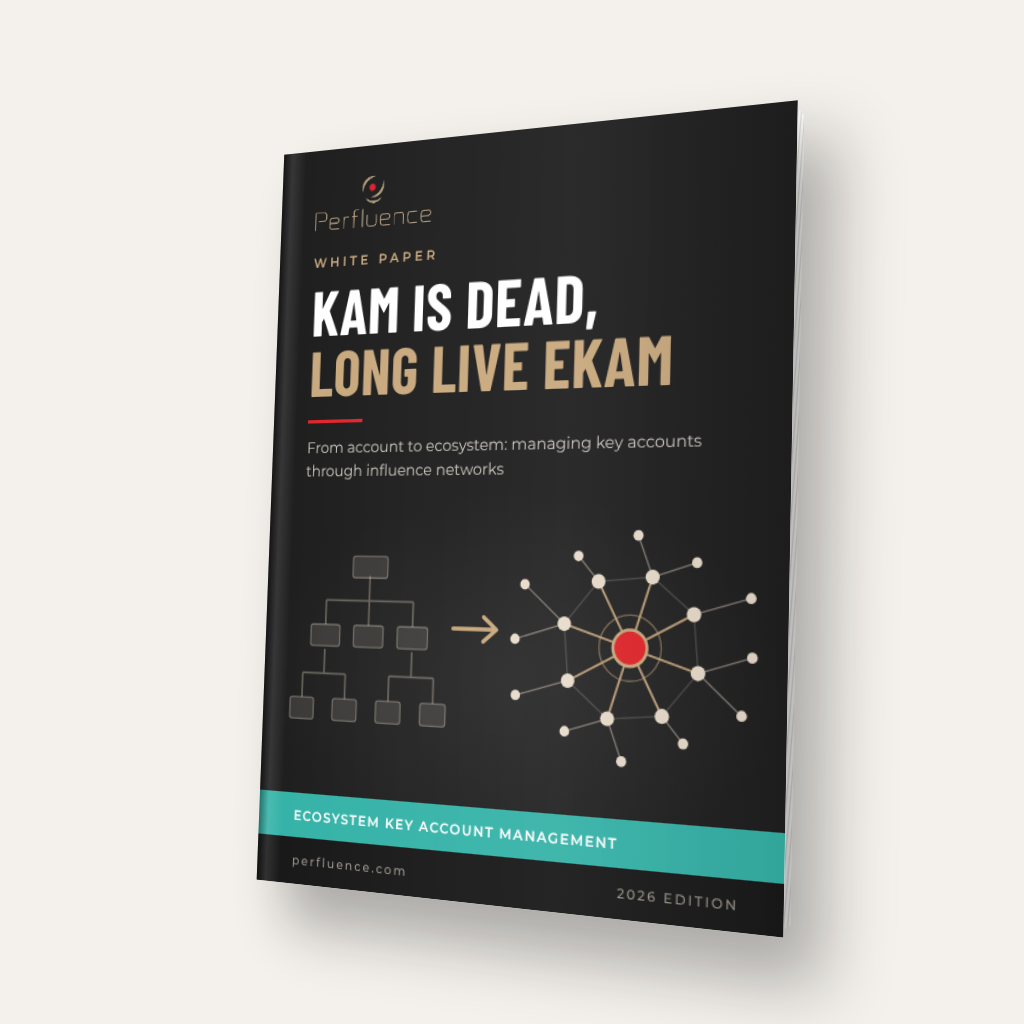
White paper: KAM is dead, long live the EKAM
This white paper explains what changes when you manage the ecosystem rather than the account alone. It shows how to read real power rather than formal hierarchy, how to coordinate who engages whom across your organization, and how to turn relationships into an asset the whole company can manage. It draws on RIIM™ (Relationship Intelligence & Influence Management), the methodology developed by Perfluence with strategic account teams.
White paper: Influence Reborn, Rethinking power, trust and growth in B2B relationships
This white paper explores that gap between awareness and practice. It looks at where organizations stand today, what separates the most mature teams from the rest, and how to move from intuition to method: mapping real power rather than the org chart, building political risk into account reviews, coordinating engagement, and managing relationship capital as a true corporate asset.